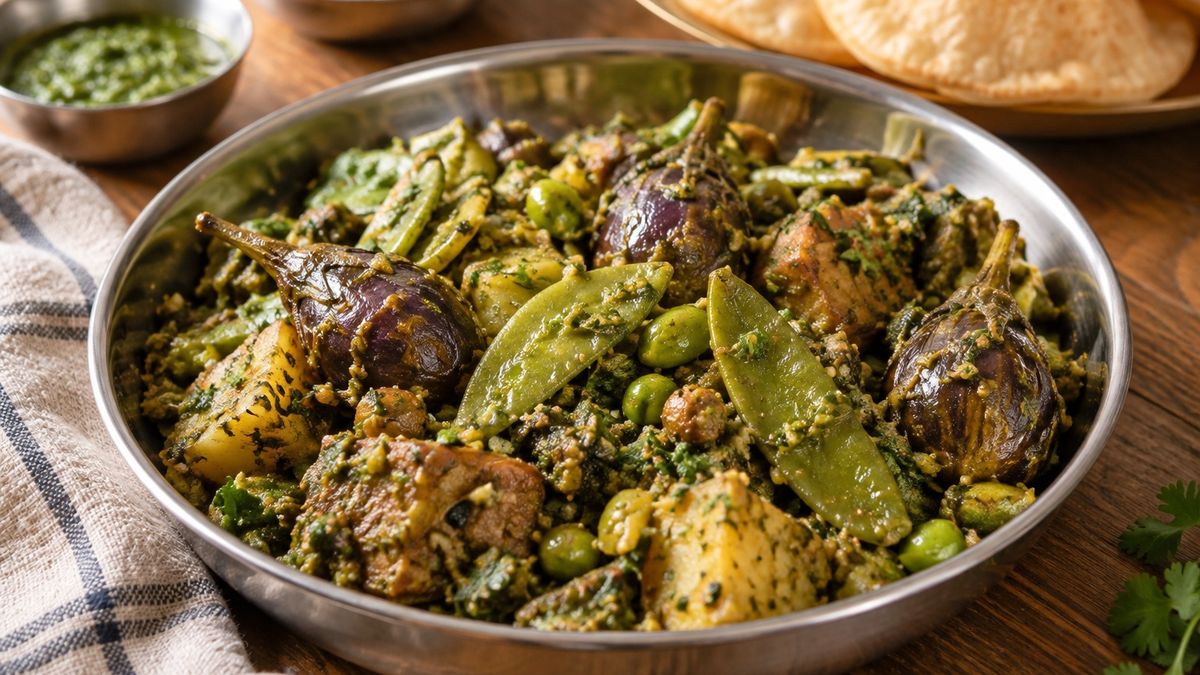
Why does undhiyu turn dark?ઊંધિયું કાળું પડી જાય તો?
The green in undhiyu comes from coriander and green garlic leaves, and that green does not survive prolonged heat; the longer it cooks, the more it turns a dull brown. At the same time, cut aubergine and potato darken as soon as air reaches the cut surfaces. So a dark undhiyu is two things added together: too much heat on the green masala, and too much air on the cut vegetables.
What is going wrong
Green masala cooked too long
The green colour in coriander and green garlic breaks down gradually with heat, and the longer the pot simmers the browner it gets. Stir all the masala in at the start and cook it right through and the whole dish goes dull, losing the fresh smell as well. Keep half the masala for stuffing the muthiya and vegetables and add the other half in the last ten minutes.
Cut aubergine left standing in air
The moment aubergine and potato are cut, the exposed flesh reacts with air and starts browning, and that brown then shows up all through the cooked dish. If you can watch the pieces going dull on the board, that is your cause. Cut them and get them straight into water, or stuff them with the green masala and keep them covered.
Left covered on the heat too long
In a covered pot undhiyu cooks in its own steam, and steam held at temperature for a long stretch breaks the colour down faster. The condensation also drips back down, dissolving the masala and spreading the brown evenly through everything. Keep the heat low, and once it is cooked, do not leave the pot sitting covered and hot.
Heat too high and the bottom scorched
An undhiyu pot is packed tight, so heat concentrates at the base and the bottom layer starts to burn on a strong flame. Stir that in and the whole dish turns dark and slightly bitter. Scrape the base and you will find a blackened crust. Use a heavy-bottomed pot and the lowest flame you can manage.
Stirred repeatedly with a spoon
Stirring breaks the vegetables, opens up more cut surfaces on the aubergine and potato, and works the masala into the liquid until everything is one uniform brown. If no whole pieces are left and the colour is flat throughout, it was over-stirred. Hold the pot by both handles and shake it instead, or turn it over once, carefully, from the bottom.
What to do right now
An undhiyu that has darkened will not get its colour back, and it is better to accept that. What you can still fix is how it looks and tastes: off the heat, scatter freshly chopped coriander and a little grated coconut over the top, then squeeze in lemon juice. The acid lifts the flavour and the coriander puts some green back on the surface. If the base has burned, do not stir at all. Lift the good upper portion into another pot and leave the burnt layer behind.
Getting it right next time
- Stuff or submerge the aubergine and potato as soon as they are cut; do not leave them exposed.
- Split the green masala in two, half for stuffing and half for the final ten minutes.
- Heavy-bottomed pot, the lowest flame, and a griddle underneath if your burner runs hot.
- Shake the pot rather than stirring, and turn it over only once.
- Take the lid off as soon as it is done, and add coriander and lemon at the end.
Related questions
Why do the muthiya go dark in the undhiyu?
Fried muthiya left in the pot for a long time soak up the liquid and deepen in colour, and the green of the fenugreek fades with the heat as well. Add them near the end, ten or fifteen minutes before serving. Put them in too early and they also break apart, and the crumbs darken the whole dish.
Can I make undhiyu a day ahead?
You can, though the colour will be noticeably deeper the next day, which is simply what happens. If you want to prepare ahead, cook the vegetables and muthiya through but hold back the last portion of green masala, the coriander and the lemon until you serve. Reheat slowly on a low flame with the lid only partly on.
Should the lemon go in during cooking or at the end?
At the end, off the heat. Lemon's sourness fades when it is boiled and what remains tastes heavy, whereas added last it reads as freshness. If you want sourness during the cooking itself, tamarind or raw tomato is the better choice, since both hold up to simmering in a way lemon does not.