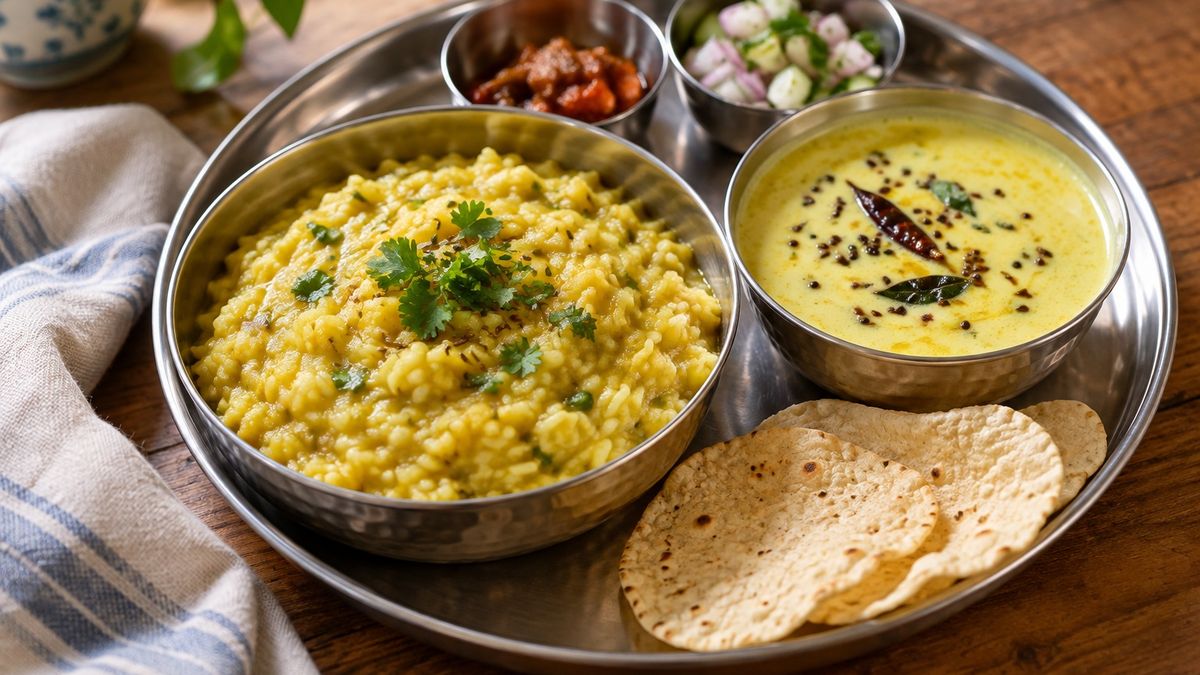
Why does kadhi split?કઢી કેમ ફાટી જાય છે?
Kadhi splits when the protein in the yoghurt clumps together under heat, turning what should be a glossy sauce into something grainy with watery patches. Only three or four things cause it, and all of them are under your control at the stove. Better still, a split kadhi can usually be brought back rather than thrown out.
What is happening in the pan
Yoghurt holds fine protein particles suspended in liquid. Heat makes those particles start sticking to one another, and once enough of them join up you can see them as grains in the sauce. Gram flour works against this in two ways: its starch thickens the liquid and physically gets between the protein particles so they cannot easily meet. Constant stirring does something different again, keeping any one patch of the pan base from running much hotter than the rest. Salt pushes in the opposite direction and encourages the proteins to join up sooner, which is why it goes in late. Flour, stirring and the timing of the salt are the three levers you actually have.
Faults that look like splitting but are not
A thin kadhi is not a split kadhi. Thin kadhi is still smooth, just watery, and a little gram flour slurry or a few more minutes of simmering will fix it. Lumps are also a different problem: if the gram flour was not whisked out properly you get pale blobs floating in an otherwise smooth sauce, and a sieve removes them in seconds. A thin slick of ghee on the surface from the tempering is normal and means nothing. The most common wrong response is adding water to a split kadhi, which only dilutes it. The grains stay exactly where they were.
Catching it early
The risky window is the five to seven minutes before the first boil, so that is the stretch to stand over. Lift the spoon and look at its back. If the kadhi runs off glossy and even, you are fine; if you see tiny pale specks clinging to the metal, it has started. Watery liquid separating at the rim of the pan is the other early sign. Old, very sour yoghurt will reach that point faster, so increase the gram flour a little when you are using it. Keep the flame moderate throughout; a hard boil splits kadhi faster than a gentle one ever will.
Rescuing this batch and preventing the next
Take the pan off the heat straight away. Whisk two or three tablespoons of gram flour into cold water until completely smooth, stir it through the kadhi, then beat hard with a whisk or a hand blender until the grains break up. Reheat gently, stirring, and stop short of a boil. For a properly smooth sauce, pass it through a sieve. If it is badly split, serve it as it is alongside khichdi, where a thicker, dal-like texture is no loss and the flavour is unaffected. Next time, whisk yoghurt, gram flour and water together cold, stir until the first boil, salt it afterwards, and add the ghee tempering last.
Questions people ask
Can I use sour yoghurt for kadhi?
Yes, and many households deliberately keep yoghurt a day or two to get that tang. Sour yoghurt does separate sooner under heat, so make two adjustments: use a little more gram flour than usual, and keep the flame moderate. Stay at the stove and keep stirring until the kadhi has come to its first boil.
Can yoghurt go in straight from the fridge?
It can, but not straight into a hot pan. Take it out, whisk it cold with the gram flour and water until there are no lumps at all, then put the mixture on the heat and let it warm up gradually. Tipping cold yoghurt into an already hot pan is one of the easiest ways to split it.
Is split kadhi still fine to eat?
Yes. Nothing has gone wrong beyond texture, and the flavour is unchanged. Whisk in a gram flour slurry off the heat and beat it smooth, or push it through a sieve if you want it properly glossy. If neither works, serve it with khichdi, where the thicker consistency reads as a dal rather than a fault.
Kadhi splits when the protein in the yoghurt separates under heat and the sauce turns grainy. Three things cause it.
1. You stopped stirring
Kadhi must be stirred constantly until its first boil. Walking away for two minutes is the most common cause.
2. Not enough gram flour
The gram flour holds the yoghurt together. Use at least three tablespoons per cup of yoghurt, and whisk it completely smooth.
3. Salt added too early
Salt makes yoghurt curdle sooner. Add it only after the kadhi has boiled.
How to rescue a split kadhi
Take it off the heat, whisk a little gram flour into water, stir it in and simmer gently while stirring. It usually comes back together.