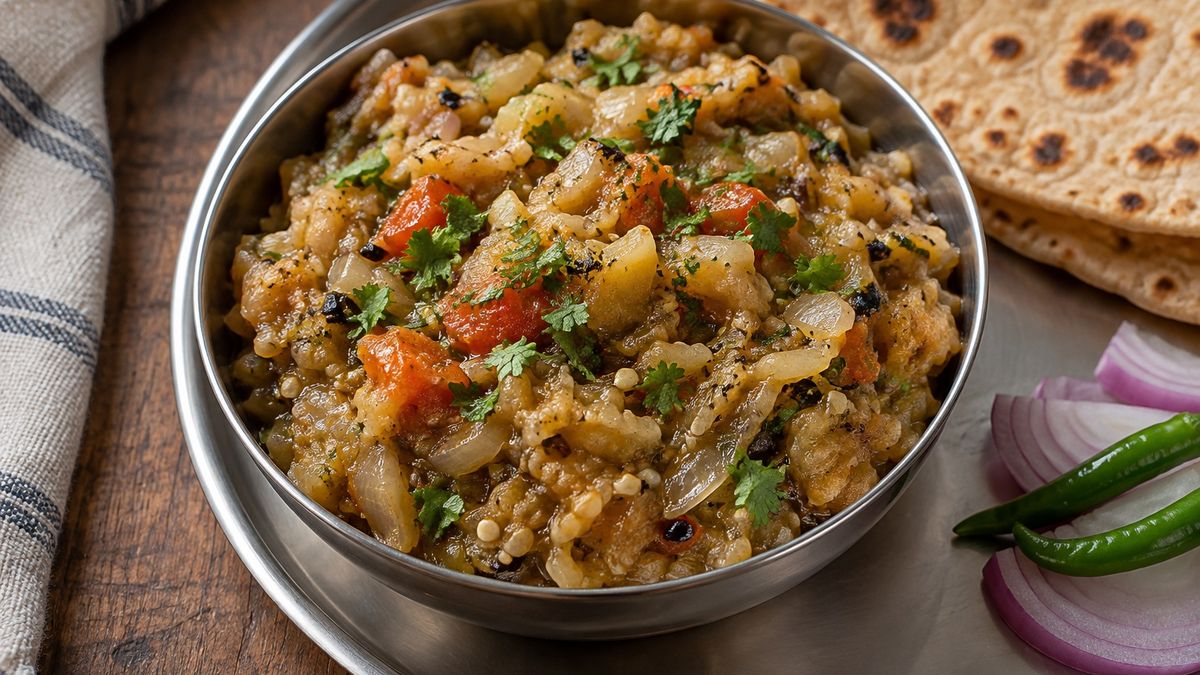
Ringan no Oloરીંગણનો ઓળો
Olo is the heart of a Kathiyawadi meal: brinjal roasted directly over the flame until smoky, then mashed with garlic, tomato and green chilli. Serve it with bajra rotla, a lump of jaggery and white butter, and you have the classic Saurashtra winter dinner.
Ingredients
Tap an ingredient to tick it off while you shop or measure.
- 1 large brinjal (aubergine)
- 4-5 garlic cloves, chopped
- 1 onion, 2 tomatoes
- 2 green chillies
- 3 tbsp oil, cumin, asafoetida
- Turmeric, red chilli powder, coriander-cumin powder, salt
- Coriander, bajra rotla and white butter to serve
Method
- Rub the brinjal with oil, make slits and push garlic cloves inside.
- Roast directly over the flame, turning, until the skin is charred and the flesh is soft.
- Cool, peel off the skin and mash the flesh.
- Fry cumin, asafoetida, garlic, onion and chillies in oil, add the tomatoes and cook until they break down.
- Add the spices and mashed brinjal and cook 8-10 minutes.
- Finish with coriander and serve with bajra rotla, jaggery and white butter.
Tips
- Flame-roasting is what gives olo its smoke; an oven does not come close.
- Stuffing garlic in before roasting carries the flavour right through.
- Jaggery and white butter on the side are part of the dish, not extras.
Storing and reheating
It keeps three days in the fridge and the garlic and spices taste more settled on day two. In summer, do not leave it out more than four hours. Reheat in a kadhai with a teaspoon of oil over medium heat, stirring; a microwave leaves olo watery and flat. The roasted flesh can be refrigerated a day ahead, though the smokiness fades.
What you can swap
- With no gas flame, roast on a tawa on an induction or glass hob, or in the oven. To bring the smoke back, do a dhungar on the finished olo: put a lit piece of charcoal in a small bowl, spoon ghee over it and cover the whole pan for five minutes.
- If you cannot find a large bharta brinjal, use four or five small ones. They are proportionally more skin, so roast them a little longer and peel carefully.
- If you avoid onion, leave it out and add an extra tomato. Garlic and cumin carry this dish, and olo does not taste thin without onion.
- If the tomatoes are bland, add half a teaspoon of tamarind pulp or a pinch of amchur. Brinjal is mild on its own and a little sourness lifts it.
What to serve with it
This is winter food, when brinjal and bajra are both at their best. Beyond rotla, it is eaten with rotli, bhakhri or khichdi. On the thali it usually comes with wedges of raw onion, a green chilli and a glass of chaas.
Mistakes to avoid
- Do not take the brinjal off the flame too early. Press near the stem with a finger; it should collapse completely. Half-roasted brinjal stays bitter and spongy in the middle.
- Keep flakes of charred skin out of the flesh. They do not add smokiness, they add the bitter taste of ash. Check the pulp once after peeling.
- Do not put the flesh through a mixer. Olo should stay a little coarse; a mixer turns it into a smooth paste and then it is not olo any more.
- Do not economise on the oil. This needs more than an ordinary sabzi, and with too little, the brinjal tastes raw and dull.
Questions people ask
Why did my olo turn out bitter?
Usually the brinjal was not cooked through, or it was an old one full of mature seeds. When buying, a brinjal should feel light for its size with glossy skin; a heavy one is packed with seeds. If the bitterness is already there, half a teaspoon of jaggery and a squeeze of lemon will mask some of it.
Is olo the same as baingan bharta?
They are close but not the same. Gujarati olo is heavy on garlic, uses little or no garam masala, often has no onion at all, and is eaten with bajra rotla, jaggery and white butter. Punjabi bharta usually has onion, garam masala and often peas.
My brinjal keeps bursting on the flame. What should I do?
The steam inside has nowhere to go. After oiling it, cut three or four lengthwise slits and leave the stem on, since it gives you something to hold. Keep the flame at medium rather than full, and keep turning it.