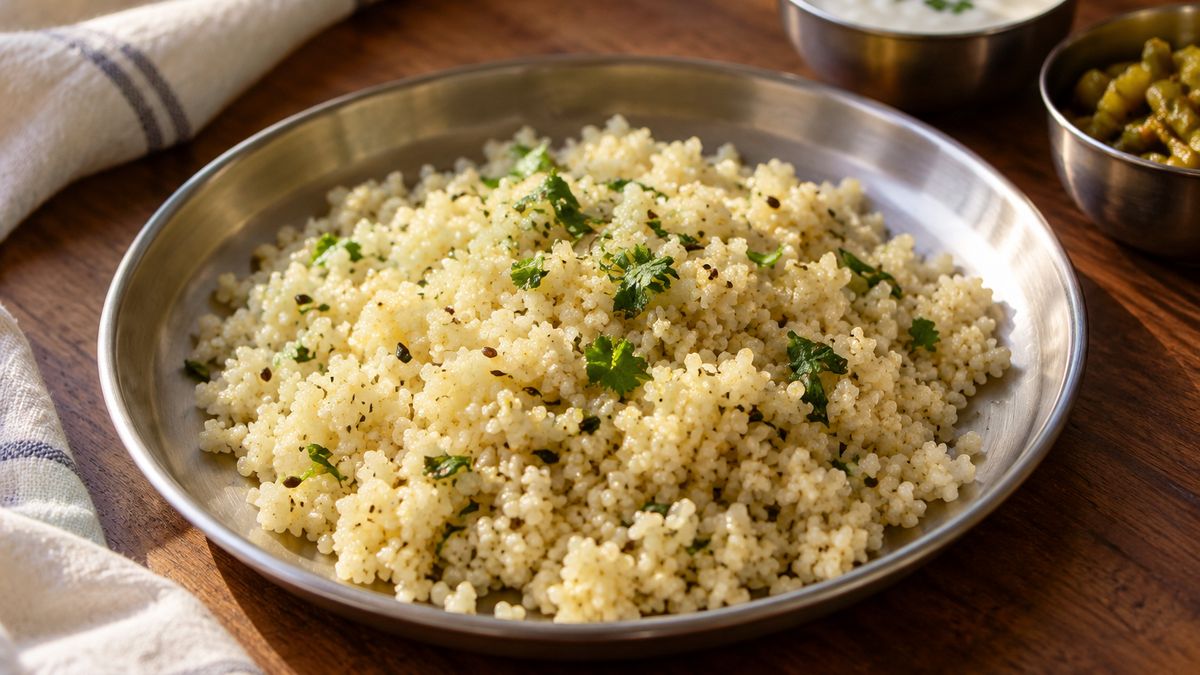
Samo na Bhaatસામાના ભાત
Samo millet cooked like rice and served with a fasting-day kadhi of curd and rajgara flour. It is filling without being heavy, which is exactly what a fast needs.
Ingredients
Tap an ingredient to tick it off while you shop or measure.
- 1 cup samo millet
- 2½ cups water
- 1 tbsp ghee, cumin, 2 green chillies
- ¼ cup crushed roasted peanuts
- Rock salt, lemon, coriander
- Farali kadhi: 1 cup curd, 2 tbsp rajgara flour, 2 cups water, ginger-chilli, ghee, cumin
Method
- Rinse the samo and soak it for 10 minutes.
- Crackle cumin and chillies in ghee, then add the samo, water, salt and crushed peanuts.
- Cover and cook on low for 12-15 minutes, then rest 5 minutes off the heat.
- For the kadhi, whisk the curd, rajgara flour and water smooth, bring to a boil while stirring and simmer 10 minutes.
- Pour over a ghee-and-cumin tempering.
- Fluff the samo, finish with lemon and coriander, and serve with the kadhi.
Tips
- Samo cooks faster than rice, so watch it.
- Stir the kadhi until it boils or the curd splits.
Storing and reheating
Samo keeps two days in the fridge but the grains turn hard and dry as they cool. Sprinkle over two tablespoons of water, cover, and steam it back to life; dry-reheating in a pan breaks the grains up. The farali kadhi keeps two days too. Reheat it on low heat, stirring constantly, or the curd will split. It thickens in the fridge, so thin it with water.
What you can swap
- Water chestnut flour or two tablespoons of arrowroot can replace rajgara flour in the kadhi. Arrowroot gives a more translucent and slightly slippery result.
- If samo is unavailable, bhagar (varai) or amaranth grain work for a fasting day. On a non-fasting day, cracked wheat cooks the same way.
- For a peanut allergy, use coarsely crushed cashews or sesame seeds instead, and add a little more ghee, since you lose the richness the peanuts provide.
- If the curd is very sour, add half a teaspoon of sugar or jaggery to the kadhi. Many homes consider jaggery acceptable on a fasting day.
What to serve with it
This is a complete fasting-day meal: samo, farali kadhi, a dry potato sabzi on the side and curd with rock salt. On Ekadashi, Janmashtami, through Navratri and on Shravan Mondays, it is the most common farali meal in a Gujarati home.
Mistakes to avoid
- Measure the water rather than guessing. Samo absorbs more than rice does: two and a half cups of water to one cup of grain. Too little and the grains stay raw in the centre.
- Do not keep lifting the lid. Lost steam means the top layer stays dry. Leave it alone for the first twelve minutes.
- Do not stir it the moment it is cooked. Let it rest covered for five minutes, then separate the grains with a fork. Stirring it hot turns it into a sticky lump.
- Whisk the curd and flour into cold water only. Flour added to warm water forms lumps that will not break down afterwards, however long you stir.
Questions people ask
Why does my samo turn sticky and lumpy?
Three usual causes: too much water, not draining it properly after rinsing, or stirring it as soon as it cooked. Rinse, drain thoroughly, then add it to the ghee, and leave it untouched for five minutes once done.
Can split farali kadhi be rescued?
Often, yes. Take it off the heat, dissolve a teaspoon of rajgara flour in two tablespoons of cold water, stir it in, and hold it on low heat for two minutes while stirring. If it has split badly, let it go; boiling only makes it worse.
Can samo be cooked in a pressure cooker?
Yes, but one whistle is enough and use two cups of water rather than two and a half. Samo overcooks quickly under pressure, so switch off right after the whistle and let the pressure drop by itself.