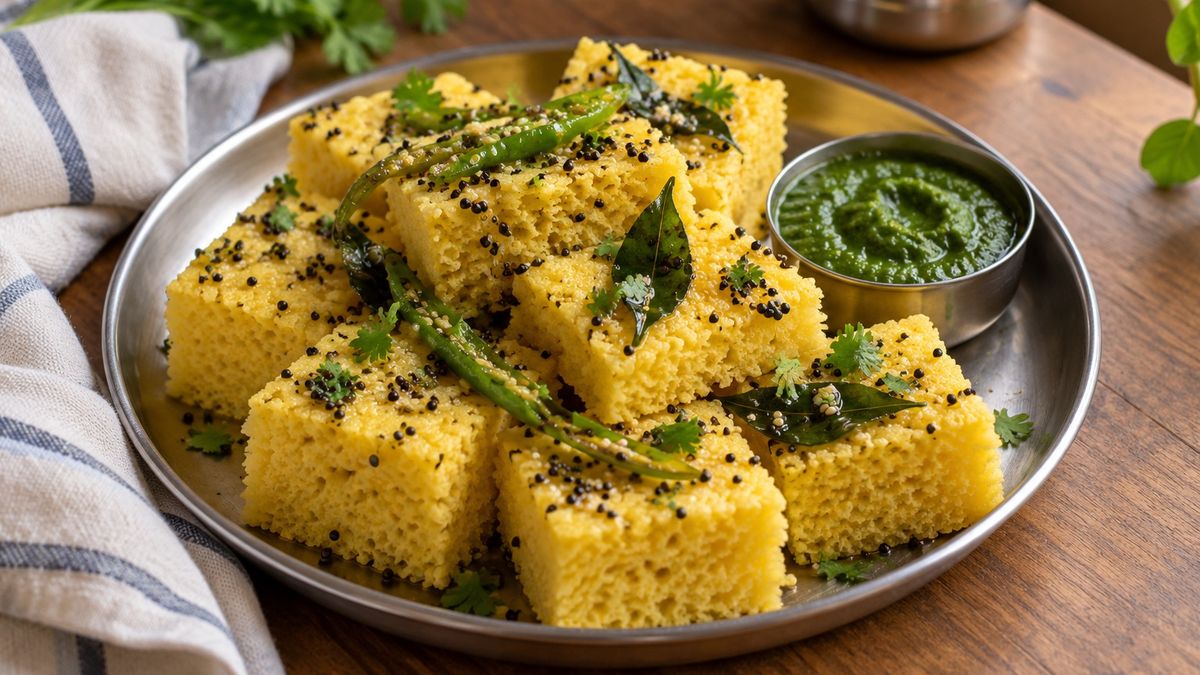
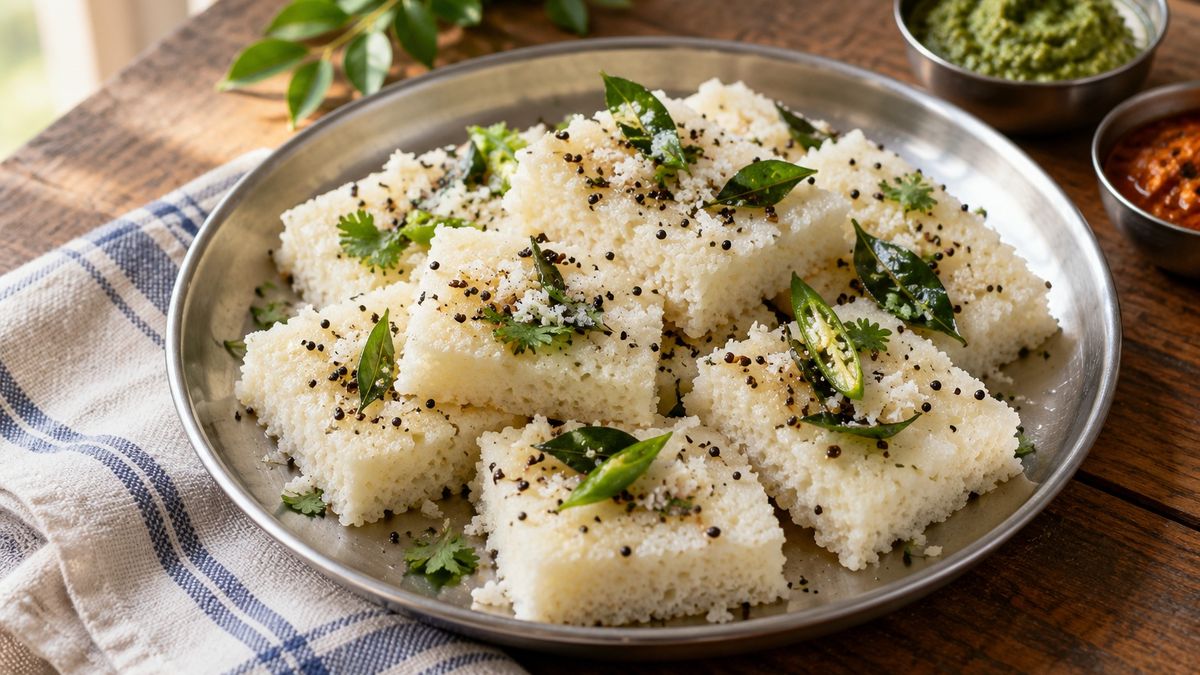
Why is my khaman dense?ખમણ પોચાં કેમ નથી થતાં?
Dense khaman is usually a timing problem rather than an ingredient problem. Eno fills the batter with gas, and steam has to set the batter around that gas before it escapes, and the window between the two is very short. Below are the mechanism, how to read the fault from the piece in front of you, and what to change.
What makes khaman rise
Eno and soda release gas the instant they touch wet batter. That gas forms fine bubbles, and if the batter is thick enough the bubbles stay trapped where they formed. Steam then sets the gram flour around them, locking in the open texture. The point to understand is that gram flour has no gluten, so nothing elastic is holding those bubbles in place. The only things doing that job are the thickness of the batter and the speed at which steam sets it. Let either one slip, by making the batter too thin or by putting it over water that is not yet boiling, and the gas simply leaves before the structure forms.
Dense, rubbery and sunken are three different faults
Read the cut piece. If it is low, heavy and close-textured all through, the gas never got held: thin batter, stale Eno, or too long a gap before steaming. If it rose well but chews like rubber, the cause is different, usually over-steaming or over-mixing after the Eno went in. If it domed up and then sank in the middle, suspect too much raising agent or a lid lifted partway through. A soapy, bitter aftertaste points to one thing only, which is too much soda. Diagnosing correctly matters, because the fix for a dense tray is the opposite of the fix for a rubbery one.
Three checks worth doing before you commit the batter
Test the Eno. Drop a pinch into a spoonful of water; it should fizz up hard. A lazy few bubbles means the packet has been open too long. Test the batter. Lift a spoonful and let it fall from a height: it should drop in a ribbon, roughly the consistency of well whisked yoghurt, not run off like water. Test the steam. The water underneath must already be at a rolling boil with visible steam before the tray goes in, and tying a cloth under the lid stops condensation dripping onto the surface. Then leave it alone for ten minutes before checking with a skewer at twelve to fifteen.
Saving this tray and improving the next one
A dense tray is not wasted. Crumble it, temper mustard seeds, sesame and green chilli over it, and finish with coconut, coriander and lemon for sev khamani, which is the best possible use for khaman that did not rise. If it is only slightly heavy, three or four more minutes back in the steamer will soften it. For the next batch, whisk the batter and let it rest covered for fifteen to twenty minutes so the flour hydrates, then check the thickness again. Grease the tray, have the steam going, and add the Eno absolutely last: stir gently in one direction for five seconds, pour, and steam immediately.
Questions people ask
Can I use baking soda instead of Eno?
Yes, but soda needs acid to react with, so the batter must already contain yoghurt or lemon juice. Start with less than you think you need until you know the quantity, because excess soda turns khaman a deeper yellow and leaves a soapy bitterness. Treat it exactly like Eno: stir it in and get the tray into the steamer at once.
Can the batter be made ahead?
Yes, as long as the Eno is left out. Whisk the gram flour, water and souring agent and keep that in the fridge. Bring it back to room temperature before steaming, check the consistency and loosen it with a little water if it has thickened. The Eno goes in only in the last few seconds before you pour the batter into the tray.
Why is shop khaman so much lighter than mine?
Shops work with a thinner batter, a higher proportion of raising agent, and large steam cabinets that are already running at full steam all day, which together give a very light, spongy piece. That style is often sold under the name nylon khaman. If you want to move in that direction at home, thin the batter slightly and make sure the steamer is at a hard boil.
Dense khaman almost always comes down to one of these.
1. You waited after adding Eno
The batter must go into the steamer within 20 to 30 seconds. After that the air has already escaped.
2. You over-mixed
Stir gently in one direction for five to seven seconds only. More mixing knocks out the froth.
3. The batter was too thin
It should be about as thick as whisked yoghurt. A thin batter cannot hold the air.
4. Old Eno or soda
An open packet loses its fizz. Use a fresh one.
5. The steam wasn't ready
The water must already be boiling. Starting in a cold steamer gives flat khaman.
6. You opened the lid
Leave it closed for the first 12 minutes or the middle sinks.